AI-First SDET · Granada, Spain · remote, hybrid in Málaga, or on-site in Granada

10 years of validation, now amplified by agents.

Emergency-call certification for BMW, robotaxi perception for Daimler, patient monitors for Philips. Since 2026 I embed with the client's teams, learn their pain points, and turn that context into production software through agentic coding.

career.traceclick a run to open it
$ trace --career miguel-sanchez-tello
PASS  ficosa      c-v2x prototypes · NG112 eCall     2016–19
PASS  daimler     robotaxi perception KPIs          2019–21
PASS  philips     patient-monitor kernel migration  2021   
PASS  bmw         eCall + ERA-GLONASS certification 2021–26
PASS  agentic r&d winifred · kronos · local LLMs    2026   
RUNNING french oem  MTBF framework · ~430 runs/day    2026–  
6 spans · 5 passed · 1 running
10yrs
testing safety-critical systems
<3mo
to 24/7 production, solo, AI-First
~430/day
automated test runs, daily, traceable
300+
tests for BMW's 5G/eCall EU and ERA-GLONASS certification
−80%
flaky tests on a suite nobody trusted; trust up to ~95%

01 — Work

Systems that cannot afford to fail, newest first.

One panel for each thing I built, from the reliability framework I run today back to my first job in Barcelona. Move sideways to go back in time.

Major French OEM · OTA program · 2026 · solo

Flagship

A reliability metric the client had never measured

MTBF (mean time between failures) for vehicle telemetry services: designed, built and shipped in under three months, AI-first.

one simulated day: every square is a test run, and the failures are the ones you cause
clock
24:00
runs today
430
failures
0
MTBF
no failures yet
Pull a cable onMTBF is the hours run, divided by the failures.
Problem
How long does the car's telemetry run without failures? The question went to 5 manual-testing teams spread over 3 offices. Nobody had tested this before. Then it was handed to me.
Approach
I sat with the teams to learn their tools and pain points, and turned them into specs for agentic coding. Then I built the whole stack: scheduled Robot Framework runs driving SOME/IP, CAN and offboard APIs, a PostgreSQL trace store, GitLab CI, and the network paths into each office, negotiated with each office's IT department.
Outcome
In production 24/7 since month three:
  • ~430 tests a day
  • every test run is traceable to every command sent and its output
  • KPIs and bench utilisation statistics are used by the head of the client's European testing
  • scalable to dozens of benches
  • Robot Framework
  • FastAPI
  • PostgreSQL
  • Grafana
  • APScheduler
  • Docker
  • GitLab CI
  • SOME/IP
  • CAN
  • ADB
  • VS Code Copilot
  • Pi agent

Jember, for BMW · remote · Nov 2021 – Jan 2026

eCall, in five seconds

For four years I tested what happens in the seconds after a crash. Pick a standard and crash the car. Gently.

  1. waiting for a crash…
300+
automated tests behind EU and ERA-GLONASS certification
90%+
coverage, and the certification passed
−80%
flaky tests, on a suite nobody trusted
8
engineers led, distributed, under Scrum
  • Python
  • Pytest
  • Jenkins
  • Docker
  • 5G/LTE
  • eCall
  • Scrum

Philips Medical, through Alten · Böblingen · Jan – Aug 2021

life-critical

A new Linux kernel for patient monitors

IntelliVue patient monitors are life-critical devices, so a new kernel is not a routine update.

I worked inside Philips' team in Böblingen and carried the monitors from Linux 3.x to 4.x, across more than 300 kernel commits, in C and C++.

Then I built the Python library that validated how the devices behaved after the migration. Same monitor, new kernel, behaviour validated.

300+
Linux kernel commits migrated
3.x to 4.x
on life-critical devices
IEC 62304
and ISO 13485, the medical-device rules I worked under
  • C/C++
  • Python
  • Linux kernel
  • Git
  • Azure Pipelines
  • Scrum
illustration: no real patient, no real screen
Linux 3.x
300+ commits
Linux 4.x
  • ✓Python library: behaviour after the migration validated

Bosch and Daimler, through Alten · Stuttgart · Jul 2019 – Jan 2021

SAE L4/L5

The data behind a robotaxi launch

Daimler and Bosch were building a robotaxi at SAE levels 4 and 5, where the car does the driving. What the cars saw came back as terabytes of Lidar and camera data.

I worked on site inside the client's team in Stuttgart and built the big-data pipelines that analysed it, with Python, pandas, Airflow, Pytest and Docker.

Those pipelines delivered more than 20 use-case tests and the KPIs feeding the December 2019 launch in San Jose.

TB
scale Lidar and camera data
20+
use-case tests, plus their KPIs
Dec 2019
San Jose robotaxi launch
  • Python
  • pandas
  • Airflow
  • Pytest
  • Docker
  • Lidar
  • Computer vision
illustration, not Daimler data
  1. TB of Lidar + camera
  2. Airflow
  3. pandas
  4. Pytest
  5. 20+ use-case tests + KPIs

San Jose launch, December 2019

Ficosa · Barcelona · 2016 – 2019

Mobile World Congress

5G safety demos, in front of everybody

The prototypes I built at Ficosa left the lab. They went to Mobile World Congress as 5G safety demos, alongside Nokia, Telefónica, SEAT, Ericsson and Rohde & Schwarz.

The press of the time wrote about Telefónica and SEAT showing connected-car use cases over 5G in a city, for safer driving. It also covered the first assisted-driving use case for a private car in Castilla-La Mancha, presented by Telefónica, SEAT and Ericsson in Talavera de la Reina.

5
companies around the same demos
5G
for safer driving in a city
  • 5G/LTE
  • V2X
  • C/C++
  • GNSS
Barcelona, badge on
  • Nokia
  • Telefónica
  • SEAT
  • Ericsson
  • Rohde & Schwarz
Connected cars over 5G in a city setting, for safer drivingMWC, Telefónica and SEAT
First assisted-driving use case for a private car in Castilla-La ManchaTalavera, Telefónica, SEAT and Ericsson

Ficosa · Barcelona · 2016 – 2019

pre-standard

A radio for cars, before the standard was ready

C-V2X lets cars talk to each other directly, which matters most when one driver cannot see the other. When I started on it, the standard wasn't finished.

I built pre-standard C-V2X prototypes of the TCU, the telematics box that gives a car its connection, in C and C++ on Yocto Linux.

Those prototypes are what the 5G safety demos in the previous panel were standing on.

C-V2X
TCU prototypes, before the standard
C/C++
on Yocto Linux
  • C/C++
  • Yocto Linux
  • V2X/C-V2X
  • 5G/LTE
  • CAN bus
seen from above, lit only where the driver can see: illustration
heard · 2.8 s
EYES
nothing coming
RADIO
car from the left, behind the building · 2.8 s away

The radio already knows. Your eyes still see an empty street.

Ficosa · Barcelona · 2016 – 2019

100% at eCall Test Fest

NG112: the emergency call goes all-IP

On 2G and 3G, eCall pushes the crash data through the voice channel itself. The data and the voice share one narrow line.

NG112 is the all-IP version: the call is set up over the packet network, and the crash data travels inside the call setup. I delivered an NG112 eCall system at Ficosa and integrated it with emergency-service centres (PSAPs).

It went to the eCall Test Fest and came back with a 100% pass rate.

100%
pass rate at the eCall Test Fest
PSAP
integrated with emergency-service centres
  • C/C++
  • VoIP
  • 5G/LTE
  • GNSS
  • eCall
the call setup, as a ladder
100% PASS

MSD is the minimum set of data: where the car is, and what happened.

Ficosa · Barcelona · 2016 – 2019

2G · 100% at eCall Test Fest

The truck eCall: where it crashed, and what it carries

A car's eCall tells the operator where the crash happened. A heavy goods vehicle has one more question to answer: what is it carrying?

The eCall for heavy goods vehicles adds that information to the message. I delivered one at Ficosa, running over 2G, and integrated it with emergency-service centres (PSAPs).

It passed the same exam as NG112: 100% at the eCall Test Fest.

2G
eCall for heavy goods vehicles
100%
pass rate at the eCall Test Fest
  • C/C++
  • eCall
  • GPS
  • CAN bus
  • Embedded systems
load the truck, then crash it: illustration
331203

The message the truck sends

call
automatic, to 112
vehicle
heavy goods vehicle
position
GPS fix, and which way it was going
time
of the crash
load
Oranges
load
Petrol · UN 1203 · flammable liquid

112 · the operator's screen

call
heavy goods vehicle · automatic
load
Oranges
load
Petrol · UN 1203 · flammable liquid
  • Ambulance
  • Tow truck
  • Fire brigade

Operator: The load decides who goes first.

02 — Homelab

A homelab that heals itself, with me in the loop.

Every panel here is something that runs in my house today, and the features say how I proved they work and where that proof stops. I design, build and validate it with Claude, while my local model does the chores it can be trusted with.

Homelab · runs my family's services every day

10 hosts watched

Ten hosts on one map

Hover the machines to see what they do, or replay an incident to watch a failure get fixed. The panels to the right are the pieces of it, one at a time.

All hosts healthy

Everything is green right now. Press replay to watch a simulated outage get diagnosed, approved and fixed.

Internet Internetthe outside world WireGuard VPN WireGuard VPNfamily + my phone My phone My phoneTelegram diagnosis + fix proposed Virtualization nodeProxmox VE · ZFS mirror PiHole PiHoleDNS for every device WireGuard WireGuardVPN endpoint Mosquitto MosquittoMQTT broker Zigbee2MQTT Zigbee2MQTTsensors + switches Frigate FrigateNVR · Coral TPU Home Assistant Home AssistantVM · automations Docker host Docker host25+ containers ! Hermes agent Hermes agentAI agent Backup Server Backup Serverwakes, backs up, sleeps ● Beszel agents watch every host and fire the alerts High-performance nodeRTX 3090 + RTX 3080 Local LLM llama.cpp · Qwen3.8 27B · 131K Winifred Hermes Pi OpenCode NAS NAS Synology · RAID 1 photos · files · backups Cameras Cameras→ Frigate Zigbee devices Zigbee devices→ Zigbee2MQTT UPS UPSthe router rides through power cuts; the servers recover by themselves

Hover a machine

Every box on the map is real hardware or a real service in my house.

  • Proxmox VE
  • ZFS
  • Docker
  • WireGuard
  • Home Assistant
  • Beszel
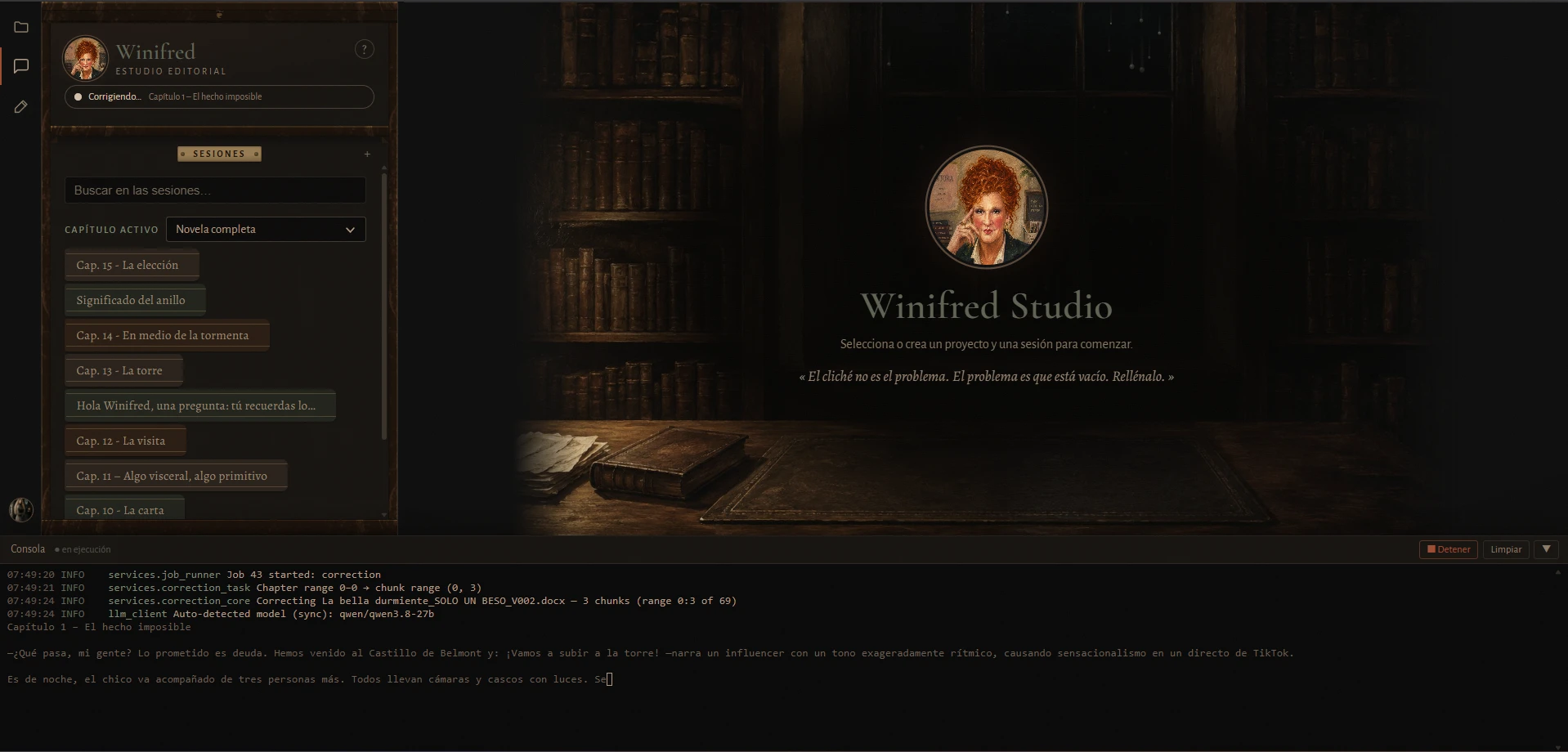
Winifred Studio: chapter sessions, Winifred's portrait and the live correction console

Side project · live

4 published authors

Winifred Studio

A self-hosted AI editorial studio for Spanish fiction authors, built first for my wife, a published romance author.

Problem
Authors want an editor who knows the whole novel, without sending unpublished manuscripts to someone else's cloud.
Approach
Multi-user FastAPI app with an opinionated editor persona, full-manuscript context, batch ortho-typographic correction, summaries and editorial packages, and resilient server-side streaming. All inference runs on my own llama.cpp server.
Outcome
In use by four published authors. No manuscript ever left the network.
What a correction looks like.

-—No sesé quequé hora es -—dijo Marta-—. El tren ya saliosalió.

6 corrections · 0 words changed
  • FastAPI + SSE
  • SQLite / Alembic
  • Alpine.js
  • llama.cpp
  • Qwen3.8 27B · 131K ctx

A 21-second tour, recorded on made-up data.

Open source · MIT

GitHub ↗

Kronos

A self-hosted work-hours tracker for people who don't want to open a spreadsheet every morning.

Problem
Knowing where you stand against your contracted hours this week, this month and all year, without a spreadsheet ritual.
Approach
FastAPI + SQLAlchemy with a zero-build Alpine.js front end, and tests at every layer, from the hours maths up to real-browser runs.
Outcome
~1,500 automated tests, ~660 of them Playwright end-to-end. Work hours are 3 clicks away now.

I Opus'ed myself this work-hours tracker. During a business trip.

  • FastAPI
  • SQLAlchemy 2
  • Alpine.js
  • Pytest
  • Playwright

Family budget · live since November 2026

22/22 routing tests

Expenses by voice note

Logging cash meant opening Actual Budget on my phone, typing it all in by hand, and refreshing at least twice until it really reached the server at home. A voice note is a much better interface!

Now I send my Hermes agent a voice note on Telegram. Whisper transcribes it at home, and the local LLM only pulls out the amount, the payee and the account. Then a locked-down agent in a throwaway container writes the entry. The LLM never gets any password, and the agent takes five orders only: add, correct, undo, balance and spent.

Actual can say OK with the network down and never sync. Therefore the agent replies "Noted" only after re-reading the entry from a fresh download.

22/22
routing tests through the agent
23
end-to-end cases, with the network cut mid-write
2
planted faults, and both turned the tests red

Designed, built and validated with Claude Opus 5.5. Tested live by both of us at home.

  • Telegram
  • Whisper
  • Hermes agent
  • llama.cpp
  • Actual Budget
  • Claude Code
Telegram · my agent
0:03
Whisper, at home"Add gasoline 30 euros, cash."
amount  30.00
payee   Gasoline
account Cash
password: never sees it
  1. locked agent writes
  2. fresh download
  3. entry found

CashGasoline−30.00

Noted ✓ Gasoline, 30.00 EUR, cash.
Nothing is recorded. It sends the note above.

25+ Docker containers · every morning

4/4 broken copies caught

A maintenance guy with a manager

An earlier version of my agent once deleted a container's data volume. So the guardrail had to be structural, not a polite line in a prompt.

Every morning the agent checks each container against the image it is really running, reads the changelogs and proposes a plan on Telegram. Applying it always needs my yes. Its key runs one locked-down wrapper with nine verbs and no delete, no prune and no compose edits. Before any update it takes a backup and reads it back, and after the update a check written by Opus 5.5 runs inside the container: PASS, FAIL or INCONCLUSIVE.

The local Qwen agent does the chores. Opus 5.5 decides what "done" means, and grades the local agent's work after every update.

9
verbs the agent has, and none of them deletes
4/4
deliberately broken copies caught: 3 FAIL, 1 INCONCLUSIVE
7
low-risk services allowed; money and one-way migrations stay human-only

The checks were written by Claude Opus 5.5, which also taught the local agent the job.

  • Docker
  • Hermes agent
  • Telegram
  • Qwen3.8 27B
  • Claude Opus 5.5
Telegram · morning report
09:15 · report only2 updates ready. I read both changelogs from the project's releases.
Go with the first one.
  1. ✓backup taken, read back, checksum ok
  2. ✓updated, healthy inside 90 s
  3. ✓check written by Opus 5.5: PASS
Not today.
Nothing changes without a yes. I will report again tomorrow.
Now delete the old volume.
Refused. Deleting is not one of my nine verbs.
  1. broken copy 1FAIL
  2. broken copy 2FAIL
  3. broken copy 3FAIL
  4. broken copy 4INCONCLUSIVE

4/4 caught. None of the broken copies passed.

Local LLM · before any model swap

NO PASS is final

An exam before any model swap

There's a new model every week, and I was judging each new model, quant or build by eye. The main job of my local LLM is proofreading Spanish novels in Winifred Studio, so that is what the exam tests.

The exam has 12 chunks of text with 104 planted errors and an answer key written by hand, never by another model. A candidate may never be worse than the current setup on hard failures, such as a changed word, lost formatting or a broken dialogue line. Recall is compared with a margin taken from the baseline's own run-to-run spread.

NO PASS is final. PASS is provisional until I blind-read eight shuffled A/B cases and sign it.

99.0%
of planted errors fixed by today's setup
104
planted errors in 12 chunks
~2 pt
smallest drop it reliably catches; 1 point is noise

Side effect: it caught my trusted model wrapping book titles in asterisks. Markdown in a novel!

  • llama.cpp
  • Qwen3.8 27B
  • Python
  • LLM evaluation
recall of 104 planted errors

103 of 104 fixed 99.0%

BASELINE

This is the reference every candidate is measured against.

Today's model and prompt
99.0% · baseline
Same prompt without its dialogue rules
97.1% · NO PASS
Temperature 1.0
95.2% · NO PASS

Both failures were on purpose: I broke the setup twice to prove the exam can fail.

Homelab server · two NVMe drives in a ZFS mirror

~5.7 years left

Who is wearing out my SSDs?

My server's drives were already 13% worn and taking ~112 GB of writes a day, each! I can assure you I'm not lifting 112 GB worth of plates daily, so the gym app was the first suspect.

Every hour a small script with no AI logs the writes per drive, per dataset, per container and per process. If a drive passes 20 GB an hour twice in a row, my phone gets a push. Every Monday Claude Code reads the week, digs in read-only and leaves a report on the NAS. It only pings me if something crosses a line.

The real culprits were ~6× write amplification below ZFS, plus backups copying every container's whole disk. I moved 7 containers to ZFS subvolumes, one by one, with a before and after baseline for each.

13%
worn, out of a 400 TBW rating
~6×
write amplification below ZFS
~200 GB
a week of whole-disk backup copies, found by the Monday report

Claude Code's part: it reads the week and writes the report, read-only. It never changes anything.

  • Proxmox VE
  • ZFS
  • NVMe
  • Home Assistant
  • Claude Code
writes per day, per drive
what the guests say they write11 GB
what reaches ZFS19 GB
what the flash really takes112 GB

13% worn by the drives' own counters, about 5.7 years left at this rate

Monday · Claude Code, read-onlyBackups copy every container's whole disk first: ~200 GB a week.
Fixed: 7 containers on ZFS subvolumes now.

Try to trip the alarm: press an hour to make the drive busy

A quiet day: about 5 GB an hour. The line is at 20.

Self-hosted GitLab · every repo

PROD is a human button

Tests on every push, and PROD is my button

My deploys used to be scripts I ran by hand. Now every repo follows one contract: tests on every push, an integration copy with invented data that deploys by itself, and PROD only through a manual job that I press.

Host details live in CI variables, never in a repo. The AI reads pipelines through a read-only bot, which gets a 403 if it tries to press PROD. Public mirrors are pushed only by the pipeline, through gitleaks and a denylist, and the job refuses to run if the denylist is empty.

The restore is proven too: on a throwaway second instance 12 of 12 CI variables decrypted.

403
what the AI's token gets when it tries to press PROD
12/12
secrets decrypted after a test restore
26.0 t/s
local LLM speed during a full pipeline, 25.3 without one
  • GitLab CI
  • Docker
  • Pytest
  • Playwright
  • gitleaks
push something to main: illustration
  1. Testsevery push
  2. INTdeploys by itself, invented data
  3. PRODmanual

Public mirrorgitleaks and a denylist: published

This job waits for a human.

Tests passed, INT deployed itself and the mirror was published. PROD waits for a human.

the AI's own token403 Forbidden. Read-only, as it should be.

Frigate · Google Coral TPU · no cloud

~7 ms per frame

Newer isn't better: the camera model bake-off

My cameras record and analyse everything at home with Frigate, and detection runs on a Coral TPU. YOLOv9 scores much higher than the stock model on the benchmarks, so I swapped it in. The parking stopped seeing cars.

Before deciding, I compared both on the real Coral with real frames: 10 people, 6 cars from real events and 4 parked-car frames that neither model had chosen. A grey image and noise were the negative control, and no model saw anything there.

YOLOv9 was in production for 12 minutes. The stock model stayed. Its speed was never the question: "fast, with 0 events" proves nothing.

6/6
cars found by the stock MobileDet
0/6
by three YOLOv9 variants
7.4 ms
per frame on the Coral
  • Frigate
  • Google Coral TPU
  • MobileDet
  • YOLOv9
parking camera · real event
MobileDet
✓✓✓✓✓✓✓✓✓✗∅∅
YOLOv9
✗✗✗✗✗✗✗✗✗✗∅∅

✓ found it ✗ missed it ∅ saw nothing, and there was nothing: a grey image and noise

MobileDet
YOLOv9
cars found
6/6
0/6
parked frames
3/4
0/4
ms per frame
7.4
8.4 to 17

03 — Method

Classic test frameworks, now evolved with agents.

My working model looks like a forward-deployed engineer's: close to the people with the problem, fast to production, and paranoid about proof.

  1. 01

    Embed

    Sit with the people who do the work and learn their tools and pain points first-hand.

  2. 02

    Contextualize

    Turn what I learned into rich, precise specs: the problem, the constraints and the solution ideas an agent needs.

  3. 03

    Build agentically

    Agentic coding builds the MVP while I own architecture and review. Spec to production in under 3 months.

  4. 04

    Validate & ship

    My 10 years of engineering is the safety net for agent-written code.

refine, evolve, maintain

04 — Career trace

Six spans. Five passed, one running.

Pick a span to open its run log, or keep scrolling and the trace replays itself.

span · domain · duration
  • Automotive & V2X
  • Medtech
  • AI-first engineering
PASS

Software Development Engineer · Ficosa · Barcelona

  • Pre-standard C-V2X TCU prototypes (C/C++, Yocto); NG112 eCall with a 100% pass rate at eCall Test Fest; demos at Mobile World Congress with Nokia, Telefónica, SEAT, Ericsson and Rohde & Schwarz.
PASS

Test Automation Engineer · Alten, for Bosch/Daimler robotaxi · Stuttgart

  • Built big-data pipelines over terabyte-scale Lidar/camera data for Daimler's SAE L4/L5 program; 20+ use-case tests and KPIs feeding the Dec 2019 San Jose robotaxi launch.
PASS

Test Automation Engineer · Alten, for Philips Medical · Böblingen

  • Migrated IntelliVue patient monitors across 300+ Linux kernel 3.x→4.x commits (C/C++) and built the Python library that validated post-migration behaviour on life-critical devices.
PASS

Senior Test Automation Engineer · Jember, for BMW (5G/eCall)

  • Architected the Python/Pytest + Jenkins + Docker framework behind BMW's mandatory 5G/eCall EU and ERA-GLONASS certification: 300+ tests, 90%+ coverage, certification passed.
  • Took ownership of a failing suite nobody trusted: flaky tests down 80%, trust up to ~95%, 20 new tests/week with the 8-person team I led.
  • Mentored 7 engineers and wrote 20+ guides; AI pair-programming from 2023, ~30% faster test development.
PASS

Independent R&D · AI-first retooling

  • Went deep on agentic engineering between contracts: built a dual-GPU local LLM service (llama.cpp, 131K context) serving 4 concurrent clients and kept building Winifred Studio.
RUNNING

Senior Test Automation Engineer · CELAD, for a major French OEM (OTA)

  • Entrusted solo with a brand new metric for the client: MTBF for vehicle telemetry services. Shipped the full stress-testing framework in under 3 months.
  • Embedded with 5 manual-testing teams (~30 testers); turned their pain points into specs for agentic coding (VS Code Copilot, Pi agent).
  • ~430 runs/day, 24/7, across benches in 3 offices in France and Spain. KPIs, bench utilisation included, used by the head of the client's European testing.

05 — Expertise

Domains of expertise

Testing & automation

  • Python · 7 yrs
  • Pytest
  • Robot Framework
  • Playwright
  • FastAPI
  • PostgreSQL / SQLite
  • Grafana
  • Docker
  • Linux
  • Git

AI-first engineering

  • Claude Code
  • VS Code Copilot
  • Pi agent
  • OpenCode
  • Multi-agent workflows
  • llama.cpp · multi-GPU

CI/CD

  • GitLab CI
  • Jenkins
  • Azure Pipelines

Embedded & connectivity

  • SOME/IP
  • CAN
  • ADB / Android
  • OTA / FOTA
  • eCall / V2X
  • AUTOSAR
  • HIL

06 — The engineer

From Granada, back in Granada.

I studied Computer Engineering at the University of Granada, then spent ten years testing systems where failure is expensive: in Barcelona, Stuttgart and Böblingen, remotely from 2021 to 2026, and now hybrid in Madrid.

At home I run a homelab that keeps my family off subscription services and gives me somewhere to break things on purpose. My wife is a published romance author, which is how Winifred Studio started.

Absolute maximum ratings
Safety-critical domains3 automotive · medtech · V2X
Countries worked in2 Spain · Germany
Test runs per day, current project~430
Published authors on Winifred4

Pin configuration top view

MST AI-FIRST SDET SINCE 2016 LOC1 ES2 EN3 EDU4 CERT5 MODE10 TZ9 XP8 AI7 LAB6
PINProbe a pin to read it.
LOC
Granada, Spain
ES / EN
Spanish native · English bilingual
EDU
BSc Computer Engineering, University of Granada, 2016
CERT
Playwright Testing Path, Test Automation University, 2025
MODE
Remote, hybrid in Málaga, or on-site in Granada

07 — Next step

Let's validate something that can't fail.

Test automation, AI-first builds and the hard conversations in between. In Spanish or English.